Search
Get Involved
National Projects
International Projects
Children's Letters
Donors
Participation Maps
Links
Articles
How to Find A Word
Look Up A Word Here
Literacy Legacy


Mary French, Director
wordpower@
dictionaryproject.org
 

Mary French is a member 
of The Dictionary Society
of North America


*NEW* Dictionary Project T-Shirts


Over 7,910,119 children have received a dictionary thanks to the generosity of sponsors who have participated in the Dictionary Project. Sponsors provide a dictionary for the children in their community each year, so they can enjoy the benefits of a large vocabulary.

2,331,795 dictionaries were given to students in 2007 as a gift from people who live in their town.

The Dictionary Project is a 501(c) (3) nonprofit organization. The goal of this program is to assist all students in completing the school year as good writers, active readers and creative thinkers by providing students with their own personal dictionary. The dictionaries are a gift to each student to use at school and at home for years to come. The Dictionary Project gives 95 cents of every dollar donated toward the purchase of dictionaries.

Reading is the most important skill of all. It is the starting point for all the economic and social opportunities this world has to offer. Educators see third grade as the dividing line between learning to read and reading to learn. Every year we watch The Dictionary Project grow by expanding our pool of sponsors, so more children can enjoy the benefits of owning their own personal dictionary.

Our sponsors have made tireless efforts to improve literacy and the quality of life in their communities. These volunteers are the breath of life of The Dictionary Project. Through The Dictionary Project, people feel empowered to affect change and improve education so that the children will grow up better prepared to compete in the global economy.


“What kind of evidence do you have that The Dictionary Project makes a difference in children's education?”

Several people have asked us this question or a similar one recently, so we decided to take a look at the available educational and scientific research to see if we could find an answer.

Educators in general treat the importance of dictionary usage as a given. Those who create curriculum standards certainly believe it is essential: 46 of the 50 states specifically include dictionary skills in their elementary language arts standards. The standards include the use of dictionaries to understand the meanings and other properties of words (such as part of speech), to build vocabulary, and to edit written work for correct spelling and usage. (The other four states include these skills as well, but without specific reference to dictionaries as a way to achieve them. Links to state standards can be found at http://www.education-world.com/standards/state/toc/index.shtml .) Many states also permit students to use dictionaries while taking required standardized tests. Since many schools do not have the budget to provide enough dictionaries in the classroom for each student to have one, The Dictionary Project allows more children to benefit from this resource.

Very little research has been done on how owning or using a dictionary impacts a child's learning. A single study by John R. Beech of the University of Leicester in the United Kingdom found that, “Examining dictionary skills in poor readers showed that they were significantly slower and less accurate in looking up words in a dictionary than their age peers who were average readers” and concluded, “Persuading younger children to use a dictionary more could develop their spelling skills, possibly by encouraging them to be more proactive.” (You can read the full abstract of Dr. Beech's article “Using a Dictionary: Its Influence on Children's Reading, Spelling, and Phonology” here: http://www.informaworld.com/smpp/content~db=all?content=10.1080/02702710490271819 .) We are also pleased to share that the California Dictionary Project, one of our sponsors, conducted a survey of teachers in the San Jose School District whose students received dictionaries. 93% of the teachers agreed or strongly agreed that, “The Dictionary Project is a worthwhile project for my students.”

Even without statistical evidence, the logic behind giving dictionaries to children is clear. Using a dictionary helps a child develop skills in two areas that will improve both reading and writing ability. First, independently looking up words in a dictionary requires a student to think critically, cultivating problem-solving skills. Second, by learning the meanings, part of speech, and other properties of a word, a student acquires knowledge, building vocabulary. A student who has a dictionary of his or her own is more likely to use it, and use it often, than a student who only has access to a classroom dictionary on a shelf across the room somewhere.

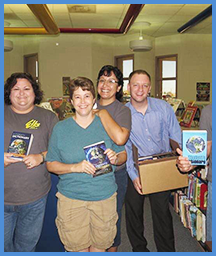
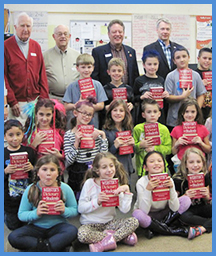
The power of the gift resides in the giving. Our sponsors who donate money to the Dictionary Project typically implement the program where they live by visiting the schools to present the dictionaries to the children. While there, they stress the importance of spelling words correctly and learning new words, because in the business world it is as important to present yourself well on paper as it is to be well groomed. Good writing conveys courtesy and respect.

The project has grown dramatically in the 13 years since it began in 1995. This bar graph illustrates the increased level of participation since the program started in South Carolina in 1995 and became a national program in 2000.

Figure 1 - Number of dictionaries and other books distributed in recent years (est.)

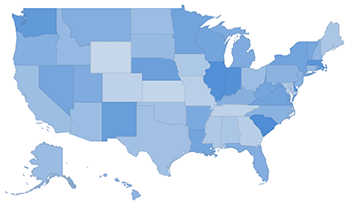
Since then residents in all fifty states have volunteered their time and raised money to provide dictionaries to the children where they live. In Idaho, Iowa, Hawaii and Utah the citizens throughout these states have provided dictionaries to every third-grade public-school student in their communities. This comment from a sponsor explains why they do it: "We have participated in this program for the last 5 years and the joy on the faces of the children is what makes this a worthwhile project." Jan Brewer, Boise, Idaho.

Here is a sampling of other notes from our sponsors:

I read about the dictionary project a few weeks ago in a newsletter. I knew immediately that I wanted to get involved; I love dictionaries. The schools in my county are covered by the Rotary Club, so I looked at other counties in western NC. I can't believe that I'm just hearing about this wonderful project. What an opportunity to be able to give dictionaries to children. It's as if you've given me a gift. ? Deirdre H., Hendersonville, NC

Last year, we were held up for a few minutes by students who wanted autographs. It seems that the dictionaries had an impact on the students and the students had a BIG impact on my members. Great Program. ? Shorewood and Lac Ste Claire Kiwanis Clubs, MI

This is the third year that our club has participated in this project and it is one of the most amazing projects I have ever been involved in. I never would have imagined the reaction that we would receive from the students. The shocked expressions when they learn the book has their name in it and that they get to keep it, the smiles, applause and hugs that we receive are truly heart-warming. ? Rotary Club of Lawton, OK

My club enjoys providing these dictionaries to the 3rd grade students in our area. The kids are so excited that people that they do not know want to give them a great dictionary that they can keep! We feel like we are making a difference in the lives of each student that receives these dictionaries. ? Verizon TelecomPioneers, TX

The kids are excited and that is the absolute best part. They all have enjoyed the books and ASKED us to do it this year themselves. That is very rewarding for our Kiwanis Club to have the kids ask for the books. This has been an incredible motivator for the children in our 4 elementary schools and our 2 middle schools. We couldn't have picked a better project. ? Kiwanis Club of Caledonia, MI

We choose to use our limited funds to buy dictionaries for children rather than to conduct studies. If you are or know an education researcher who would like to undertake a research project on how owning dictionaries improves academic performance, please let us know! We are confident that the dictionaries do have a positive impact on the children who receive them. Besides being useful gifts, the dictionaries are a powerful statement of support from the community. We know this because of the thousands of responses we have received from students, teachers, administrators, and sponsors.

Here is a sampling of some of our favorite letters from children:

Thank you for the awesome dictionary. I have had so much fun reading it. I like it so much I took it home but I brought it back to school. Thank you for realizing how much I needed my own dictionary. ? Elena, California

Thank you for the dictionary. I never had my own dictionary before. I keep it with me all the time. Just in case I need it. ? Logan, Virginia

Thank you for the dictionary. I really enjoy it. I really like it and I alredy used it. It makes me feel like I am special. I learn a lot from it. ? Carrie, Vermont

Thank you so much for the dictionary. I really like it! This dictionary had so many things I wanted to learn and now I learned it because of you! I appreciate kindness and generosity you gave to me. I will always use the dictionary you gave me! ? Ariana, California

Thank you for the dictionary. I used it a lot for home work. I like it because it helps me in a lot of ways. The book makes me feel like I can do everything. ? Steven, Vermont

Sometimes a dictionary makes a difference for a whole family:

I would like to thank you for the presentation and the dictionaries. I've used it a lot at home. So has my brother. When he can't find a word. It is very helpful when I need to find a word. My mom and dad even use it sometimes. ? Riley, New York


Why We Work in South Carolina

We wanted to understand why The Dictionary Project, which has been well received in most states, was virtually ignored in South Carolina for years.  Every third-grade student in South Carolina public schools has received a dictionary for the past eight years, thanks in part to donations from people all over the country and Rotary Clubs in Districts 7770 and 7750.  Unfortunately, we have not found local sponsors in much of the state.  We believe that these pictures of schools in South Carolina clearly demonstrate that the people responsible for making education policy and funding decisions in this state do not understand the value of education, or grasp that it is an integral part of a prosperous economy.

Corridor of Shame ( http://www.dictionaryproject.org/corridor_of_shame.asp )

Recently the  former superintendent of Charleston County schools had this to say about the school district:

http://www.charleston.net/news/2007/jun/14/pointed_words_good_feelings/ (click on link to open)

It wasn't until 1992 that standardized tests were mandated by the state of South Carolina  and administered to the students to evaluate the level of education each child received in school. The test scores validated the SAT scores already on record that ranked South Carolina 50th in the nation. SAT scores in South Carolina are rising more quickly than those of the nation as a whole, but are still well below the national average. South Carolina average scores in 2007 were 488 Critical Reading , 496 Mathematics, and 475 Writing; United States average scores in 2007 were 502 Critical Reading , 515 Mathematics, and 494 Writing. (The SAT scores on a 200-800 point scale in each subject area.) The percentage of students meeting state standards in Language Arts on the 2007 Palmetto Achievement Challenge Test (PACT) is over 85% for third graders, but falls for higher grades, to just 71% of eighth graders who meet standards. PACT scores also show significant racial disparities: While 67% of white students score proficient or advanced in Language Arts, only 38% of African-American students attain such scores. High school graduation rates, depending on the methodology used to compute them, show that somewhere between 30 and 50 percent of entering ninth graders will fail to graduate within four years. This rate is among the worst in the nation. Overall graduation rates reported by the South Carolina Department of Education have fallen every year since 2003.

(Statistics are available on the South Carolina Department of Education website, www.ed.sc.gov . Other graduation-rate studies are at http://www.unitedhealthfoundation.com/shr2004/components/hsgrad.html and http://www.manhattan-institute.org/html/cr_baeo_t2.htm .)

If you would like to start a Dictionary Project Click Here

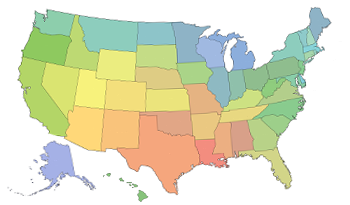
To find a list of Dictionary Projects in your state, choose from the list below:


  • Huntington Beach Elks Lodge # 1959, CA
  • Preston Elks Lodge # 1670, ID
  • Rotary Club of Calhoun City, MS
  • AT&T TelecomPioneers / Indian River Club, FL
  • Rotary Club of Edge Hill, PA
  • Marvin Moss Elementary School, NV
  • Rotary Club of Port Arthur, TX
  • West Liberty Lions Club, OH
  • Optimist Club of Twin City Area, MO
  • Lyndon Elks Lodge # 2052, KY
  • Petersburg Elks Lodge # 237, VA
  • Port Chester Elks Lodge # 863, NY
  • Rotary Club of Crossville, TN
  • Rotary District 5000, HI
  • Rotary Club of West Palm Beach, FL
  • Rotary Club of Darien, IL
  • Dictionary Project / CoronaNorco Schools, CA
  • Dictionary Project / CoronaNorco Schools, CA
  • Al Cross, IA
  • Rotary Club of West Des Moines, IA
ABC News
Wall Street Journal
American Profile
KOTV News
The State, SC Article

Past Newsletters (2007) - (2006)


Dictionary Project wins
Angel Award


National Community Service Award


Dictionary Project wins Community Quarterback Award
Learn more here....

The Dictionary Project received the Community Quarterback Award from the Carolina Panthers and a $2,000 donation from the Carolina Panthers to the Dictionary Project.  We want to thank Chris Hope of the Kansas City Dictionary Project and Jack Vealey who helped to organize the Dictionary Project throughout Rotary District 6960 for nominating us for the award.  We are truly grateful for the participation of so many people who constantly think of new ways to do more to improve literacy where they live.


International Book Bank
has helped us with recent international projects. Check their website for more information on the organization.

Home | Get Involved | Donors | Top